Research Focus

Our research focuses on the innovative design and synthesis of advanced nanomaterials, including Perovskites, Semiconductors, Plasmonic oxides, metal-semiconductor composites, polymer composites, Metal-Organic Frameworks (MOFs), and Covalent Organic Frameworks (COFs). By utilising their unique structural, optical, and electronic properties, we aim to develop cutting-edge solutions for energy and environmental challenges.
We employ advanced wet chemical techniques for precise bottom-up synthesis, enabling fine control over material composition, morphology, and functionality. These tailored nanomaterials are optimized for high-performance applications, including optoelectronics, Surface-Enhanced Raman Scattering (SERS), sensing technologies, heterogeneous catalysis, photocatalysis and water splitting. Our research also extends to energy storage, CO₂ reduction, and environmental remediation, where MOFs, COFs, and plasmonic-semiconductor composites play a crucial role in sustainable solutions.
By integrating innovative material design with advanced characterization approaches, we strive to push the boundaries of materials science, driving the development of next-generation technologies for a sustainable and energy-efficient future.
Our Key Researches:
Current Research Projects:
1. "Surface-Enhanced Raman Scattering (SERS) Sensors based on Defect-Induced Semiconducting Transition Metal Oxides Nanomaterials" : DST-SERB
2. “Biomass to Chemical: A Green Approach Towards Circular Economy and Sustainability (B2C).” : CSIR
Past Research Projects :
1. "Synthesis, Functionalization and Applications of Transition Metal Oxide Nanocrystals : CSIR NCL
2. "Fabrication of Two Dimentional Arrays of Plasmonic Nanoparticles for Solar Cell Application" : DST-SERB
3. "Improved Materials for Green Firecrackers" : CSIR
4. "Bulk Synthesis of Porous Crystalline Covalent Organic framework-materials for Methane [CH4] Storage": GAIL-India
5. "Low-Dimensional Inorganic Halide Perovskite (IHP), Organic-Inorganic Hybrid Perovskite (OIHP) and their Multidimensional Nanocomposite: Synthesis, Photophysical Properties, and Optoelectronic Applications" : CSIR

This work reports a fast, one-step microwave-assisted synthesis of a TpTTA COF and its MoO₃₋ₓ–COF nanocomposite, completed within ~1 h at 120 °C with high yield, compared to conventional multi-day methods. The resulting MoO₃₋ₓ–COF acts as a low-cost, noble-metal-free SERS substrate, delivering strong plasmonic enhancement (EF = 7.76 × 10⁴), high stability, and excellent reproducibility. It enables sensitive detection of organic dyes and hazardous pesticides, achieving a low detection limit of 12.5 ppm for the carcinogenic insecticide Mancozeb, demonstrating strong potential for environmental and food safety monitoring.

This study presents a rapid microwave-assisted synthesis strategy to achieve phase-engineered, lead-free cesium manganese bromide perovskite nanocrystals with highly pure and tunable blue, green, and red emissions. By simply varying the MnBr₂ concentration, controlled phase transitions enable RGB emission, while moisture- and thermally reversible phase changes add functional versatility. The approach offers a fast, non-toxic, and efficient route to high–color-purity luminescent materials with strong potential for display technologies, anti-counterfeiting, and secure encryption applications.

This work reports a simple solution-based strategy to tune the crystallinity of cobalt tungstate nanomaterials and evaluate them as efficient bifunctional electrocatalysts for hydrogen and oxygen evolution. The semiamorphous CoWO₄ exhibits an exceptionally high surface area (~150 m² g⁻¹), delivering superior HER and OER activity with excellent stability compared to amorphous and crystalline phases. Remarkably, a semiamorphous CoWO₄-based electrolyzer outperforms the commercial RuO₂‖Pt/C system, highlighting its strong potential for cost-effective and sustainable water-splitting applications.
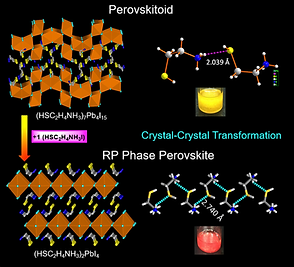
This study reports the synthesis of a novel low-dimensional hybrid perovskitoid using a zwitterionic cysteamine linker and its diffusion-driven crystal-to-crystal transformation into a Ruddlesden–Popper phase. The intermediate yellow perovskitoid exhibits a unique staggered low-D structure, exceptionally strong photoluminescence (five orders higher than the transformed red phase), and a long carrier lifetime (~143 ns), well supported by DFT calculations. Its excellent optoelectronic properties enable applications in self-powered photodetectors and selective Ni²⁺ sensing through reversible photoluminescence switching.

This work reports, for the first time, the atmospheric synthesis of all-inorganic CsPbBr₃/Cs₄PbBr₆ perovskite@COF nanocomposites with tunable crystal structures and enhanced stability. The nanocomposite retains its crystallinity even after prolonged water exposure and exhibits efficient visible-light-driven photocatalytic degradation of methyl orange with a high reaction rate (0.245 min⁻¹) and excellent recyclability over multiple cycles. These results highlight the potential of perovskite–COF hybrids as robust and efficient photocatalysts for environmental remediation.